A history of artificial intelligence, from the beginning
What is a computer?
A switch.
On or off. One or zero. A pin on a barrel, a hole in a card, a relay, a glowing tube, a sliver of silicon, a neuron in a network. For more than a thousand years people have been building machines that follow instructions, and the first ones did not calculate anything. They played music.
Scroll to travel through time ↓
c. 850 · the switch as
A pin on a barrel
On. Pin present: the lever lifts, the flute hole opens.
c. 850 · Baghdad · the switch is a pin on a barrel
The instrument that plays by itself
Three brothers in Abbasid Baghdad, the Banū Mūsā, described a water-powered flute player in their Book of Ingenious Devices. A turning cylinder studded with pins pressed levers that opened and closed the flute’s holes. Change the pins and you change the tune. It is widely considered the earliest known programmable machine: the melody was not built into the instrument, it was stored separately, as a pattern of pins. source
That is the whole idea of software, eleven centuries early. The machine stays the same; the program changes.
1206 · Upper Mesopotamia · the switch is a peg on a turning shaft
A robot band and the first drum machine
The engineer Ismail al-Jazari described a boat of four mechanical musicians that floated on a lake to entertain guests. Under the drummer, pegs on a rotating shaft lifted levers that let the sticks fall. When the roboticist Noel Sharkey rebuilt the mechanism, moving the pegs changed the beat. Whether al-Jazari himself reprogrammed it is not known, but the design is a drum machine in everything but electricity. source

Try it
Program a barrel
Every dot is a switch. Place pins, turn the barrel, then switch the view: the same program as a punched card, and as the ones and zeros a computer stores today. Nothing about the music changes. Only the switch does.
13 pins · 51 bare spots · 64 switches. Tap any spot to add or remove a pin.
1300s – 1900s · the switch is a pin on a barrel
Bells, organs and music boxes
The pinned barrel spread across Europe: tower carillons that rang tunes on the hour, barrel organs cranked on street corners, and from the 1790s, the Swiss music box with its tiny steel comb. Each tune was a program, pinned by hand into a cylinder that could be swapped for another.

1804 · Lyon · the switch is a hole in a card
The loom that read cards
Joseph Marie Jacquard replaced the barrel with something you could make as long as you liked: a chain of punched cards. Where there was a hole, a hook passed through and lifted a thread; where there was none, it stayed down. One card per row of the weave. Portrait-quality silk could be woven from tens of thousands of cards, and the same loom could weave anything you could punch.

1843 · London · the switch is a hole in a card
The first programmer imagines a composer
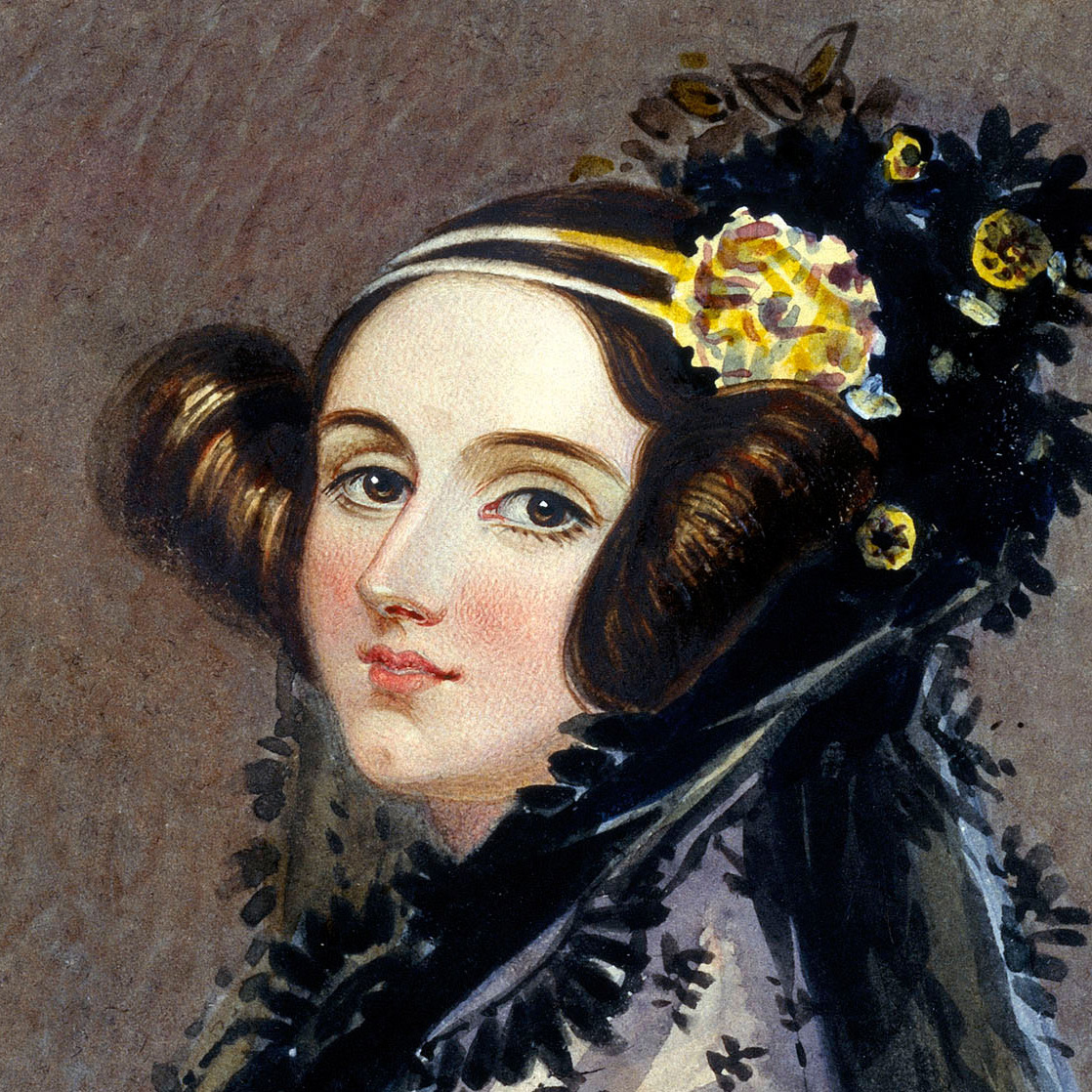
Charles Babbage designed the Analytical Engine to take its instructions from Jacquard-style cards. Ada Lovelace, translating and annotating a paper about it, wrote what is often called the first computer program, and saw further than anyone: the engine could work on anything that could be expressed as symbols. If the relations of musical sounds could be expressed that way, she wrote, the engine might compose elaborate and scientific pieces of music of any degree of complexity or extent.
source
1890s – 1920s · the switch is a hole in paper
Music machines on wagons
Fairground organs, carved and gilded and hauled from town to town on wagons, played folded books of punched cardboard as long as a song. At home, the player piano read the same kind of program from a paper roll. Millions of rolls were sold. A piano roll is a punched card for music, and a recording of a performance as a list of switches: which key, when, for how long.


1890 · United States · the switch is a hole in a card
Counting a nation
Herman Hollerith turned the card into data. For the 1890 U.S. census, each person became a card; pins pressed through the holes into cups of mercury, closing circuits that advanced counters on a dial. His company became part of IBM, and punched cards carried the world’s data for the next eighty years.


1937 · the switch is a relay
Switches can think in logic
Claude Shannon, a 21-year-old student at MIT, showed that circuits of relays could carry out Boolean logic: AND, OR, NOT, and therefore any calculation at all. A relay is a switch flipped by electricity, so switches could now flip other switches. In 1941 Konrad Zuse’s Z3 in Berlin used relays to run programs from punched film. source

1945 · Philadelphia · the switch is a vacuum tube
Eighteen thousand glowing switches
A vacuum tube has no moving parts, so it can switch thousands of times faster than a relay. ENIAC used about 18,000 of them, filled a room and drew some 150 kilowatts. Its first programmers, six women including Betty Snyder and Jean Jennings, programmed it by setting switches and plugging cables. source Across the world in Australia, CSIRAC was playing tunes by 1950–51, often called the first computer to play music. source


1947 · Bell Labs · the switch is a transistor
The switch becomes solid
John Bardeen, Walter Brattain and William Shockley made a switch from a sliver of germanium. Transistors were small, cool and cheap. By 1958–59 Jack Kilby and Robert Noyce were putting many of them on a single chip; in 1971 the Intel 4004 put a whole processor on one. Today a single chip carries tens of billions of transistors, each one the same on-or-off decision as a pin on the Banū Mūsā’s barrel. source


1931 – 1983 · the switch is a transistor
The drum machine comes home
The Rhythmicon of the early 1930s, built by Léon Theremin for Henry Cowell, played rhythms electrically. In 1957 the Illiac Suite, written with the University of Illinois’ ILLIAC computer, became what is often called the first score composed by a computer program. Then came drum machines with a row of step buttons: press a step and it sounds, leave it and it doesn’t. The barrel you programmed above is laid out exactly like them, because it is the same machine.

1950 – today · the switch is an artificial neuron
Machines that learn
In 1950 Alan Turing proposed a test for machine intelligence. source In 1955 a proposal for a summer workshop at Dartmouth gave the field its name: artificial intelligence. source In 1958 Frank Rosenblatt’s perceptron turned the switch into something that learns: an artificial neuron adds up its inputs, each with a weight, and switches on when the total crosses a threshold. Training means adjusting the weights.
Stack billions of those neurons, train them on enough examples, and you get the systems people now talk to. Underneath, they still run on transistors flipping on and off. Artificial intelligence is the newest chapter of a very old story: people teaching switches to follow a pattern, from a flute in Baghdad to the machine reading this page.

Chiller Tech Support
We still build with switches.
Automation is how a small team does big work. It’s why we build software like ServiceInstall: give the routine work to the machine and keep people for the work that needs people.
Sources and further reading
- Program (machine) — Wikipedia
- The 9th-century “Instrument Which Plays by Itself” — Hyperallergic
- Al-Jazari’s programmable drummer, reconstructed — cs4fn, Queen Mary University of London
- Lovelace, Notes on the Analytical Engine (1843) — full text
- Shannon, A Symbolic Analysis of Relay and Switching Circuits (1937) — MIT
- ENIAC — Encyclopaedia Britannica
- Invention of the point-contact transistor — Computer History Museum
- The music played by CSIRAC — University of Melbourne
- Turing, Computing Machinery and Intelligence (1950) — Mind
- The Dartmouth proposal (1955), where “artificial intelligence” was named
Images are from Wikimedia Commons; each caption names its author and license. Public-domain and CC0 images need no permission; CC BY and CC BY-SA images are shown with their required credit. The barrel’s sounds are synthesized in your browser.