You have crossed into The Planets
Gustav Holst
A life in music, and a planet at peace
Gustav Holst (1874–1934) was an English composer, teacher and trombonist whose imagination ranged from English folk song to Sanskrit literature, choral writing and the night sky. The Planets made him famous, but it is only one doorway into a body of music shaped by curiosity, discipline and a deep commitment to teaching.
Scroll to travel ↓
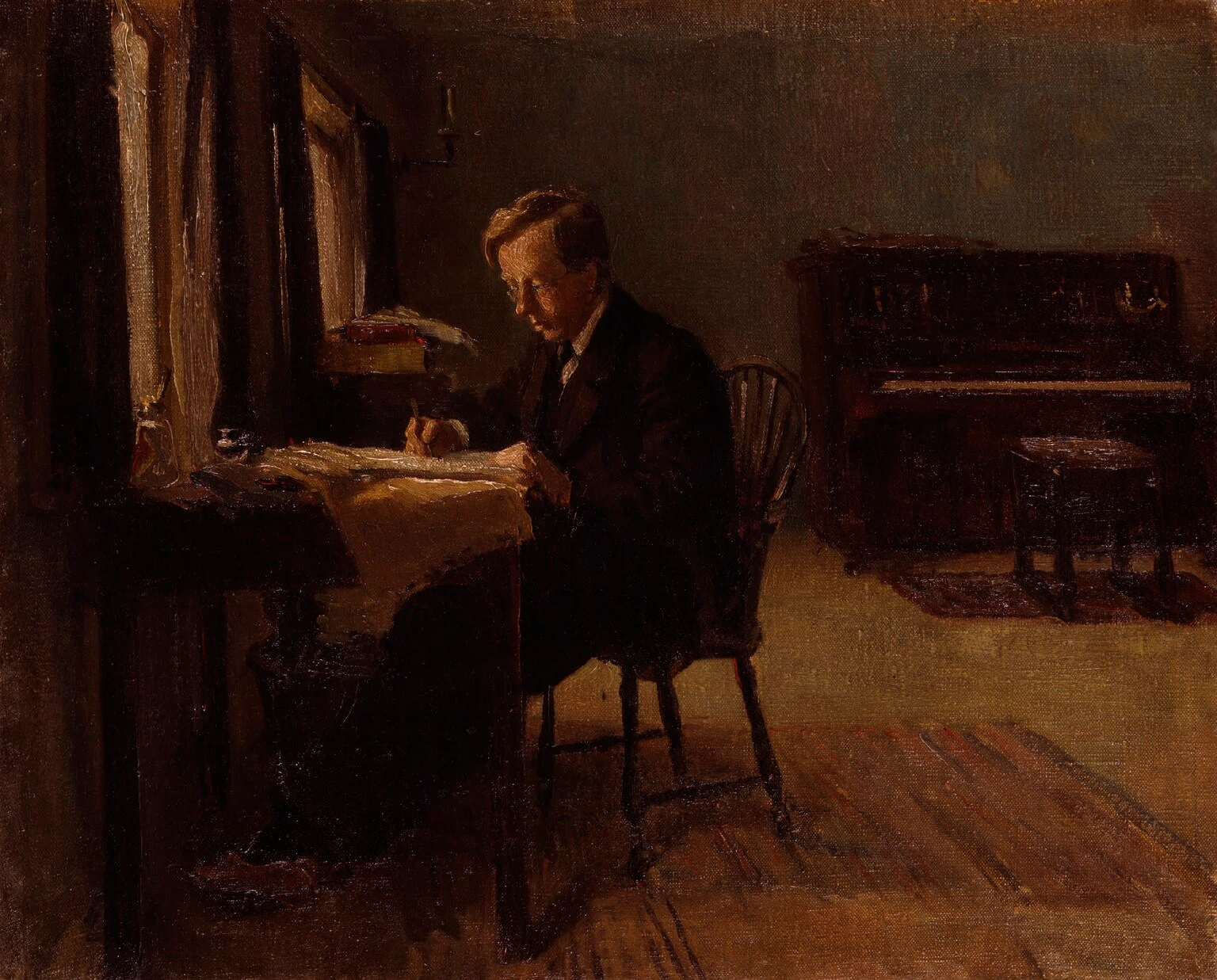
A musician who kept learning
Born in Cheltenham on 21 September 1874, Holst grew up in a musical family. He hoped to become a pianist, but neuritis in his right arm made that path impossible. He studied at the Royal College of Music from 1893, where Charles Villiers Stanford taught him composition; Holst also played trombone, an instrument that gave him practical knowledge of the sound and breath of orchestral life. In 1918, before taking a YMCA music post with troops in Salonica, he dropped “von” from his name and was known as Gustav Holst.
Holst's interests were never confined to one tradition. He was drawn to Purcell and Wagner, to English folk song, and to Hindu literature and philosophy. At University College London he studied Sanskrit, then made his own translations of Sanskrit texts before setting some as music. These were not decorations around a fixed style: they were encounters that gave him new poetic forms, rhythms and musical questions.
Alongside composing, Holst devoted himself to musical education. He taught at St Paul's Girls' School and Morley College, as well as the Royal College of Music. He and his close friend Ralph Vaughan Williams shared ideas and criticized each other's work over many years. Holst's own music often prizes clarity and economy: a sound world can be vivid without being crowded.
Holst died in London on 25 May 1934. Remembering him means remembering not only the famous orchestral colors, but also a teacher, a working musician, and a composer whose curiosity crossed boundaries.
Further reading: Royal College of Music: “Happy Birthday, Holst!”
The Planets: music, not a star chart
Holst composed The Planets, Op. 32, between 1914 and 1916. It is a seven-movement orchestral suite whose titles join each celestial name to a character: Mars, the Bringer of War; Venus, the Bringer of Peace; Mercury, the Winged Messenger; Jupiter, the Bringer of Jollity; Saturn, the Bringer of Old Age; Uranus, the Magician; Neptune, the Mystic. The movements are not arranged in astronomical order: Holst's point of departure was astrology and the imagined qualities associated with the planets, not a scientific portrait of their physical worlds. Earth has no movement; Pluto was not discovered until 1930, long after the suite was written.
The first performance was a private concert at London's Queen's Hall on 29 September 1918, conducted by Adrian Boult. The first complete public performance followed on 15 November 1920, with the London Symphony Orchestra conducted by Albert Coates. In the years since, The Planets has become a familiar presence in concert halls and a lasting reference point for orchestral music.
Movement list, history, and listening context: Berliner Philharmoniker programme note.
Venus, the Bringer of Peace
The suite's second movement, Venus, offers a spacious contrast to Mars. Its subtitle is Holst's own poetic frame—not a claim about the real planet. Listen for the way the music seems to breathe: a gentle orchestral landscape, solo lines that emerge from it, and phrases that open outward rather than charge ahead. The change of scale matters. Peace here is not an arrival announced by a fanfare; it is a mood made gradually, through restraint, color and listening.
That is one way to hear the movement, not the only one. Let it be a few minutes in which nothing needs to be conquered or explained.
A small musical afterlife
Holst's musical world has traveled far beyond the concert hall. In a 2020 Rolling Stone interview, Black Sabbath bassist Geezer Butler recalled playing the opening movement of The Planets—“Mars, the Bringer of War”—on bass around the time the band formed, and thought it may have influenced Tony Iommi's riff for “Black Sabbath.” The article is careful: Iommi himself did not specifically name Holst as the riff's source. It is a fascinating recollection, not a definitive claim of direct influence. Read the interview.
This page is an independent tribute and is not affiliated with Gustav Holst's estate, the Royal College of Music, or the U.S. Air Force.